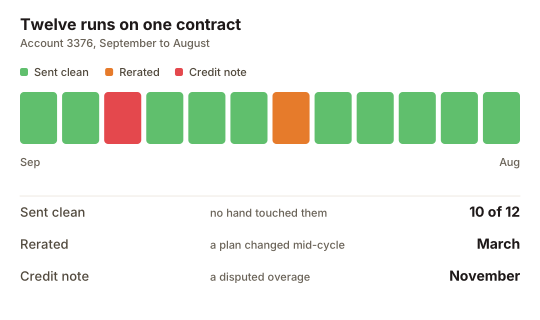
Twelve runs, and the two that needed a hand
Every billing run is recorded, including the rerate in March and the credit note in November.
Hybrid billing
Real customers do not pick a single revenue shape, so Verlix bills every shape on one contract and reports them as one number.
A base fee, metered usage and a credit wallet arrive on one invoice and in one ledger.
Use cases
Verlix handles
Every billing run is recorded, including the rerate in March and the credit note in November.
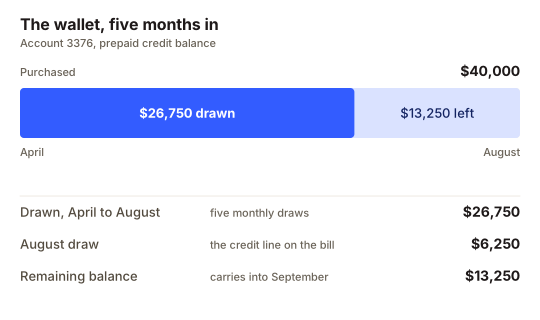
Prepaid credit draws down as usage lands, and every invoice shows what is left to spend.
Hybrid billing · seats and consumption
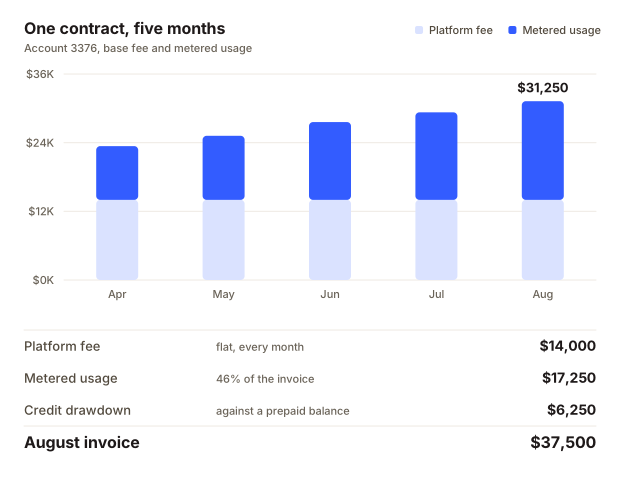
280 seats at $50 a month is the fixed half of this contract. Everything those seats then consumed is the other half, and in August it was the larger of the two.
The seat count is the platform fee divided by a $50 seat. Both halves land on one invoice and in one ledger line.
Hybrid billing · commit and true-up
$40,000 of prepaid credit, $26,750 of it drawn by August. At the current burn the balance clears at the end of October, so the overage is something you price before it lands rather than explain afterwards.
The April to August draws are the wallet's own, and the August draw of $6,250 is the credit line on that month's bill.
Prepaid balance, April to October: opens at 40,000.00, 3 movements, closes at 0.00.
Hybrid billing · the ramped contract
Account 4181 steps its platform fee at the anniversary while the meter runs underneath it. Verlix reads the step from the contract and applies it on the date, and by the last quarter the meter has passed the fee.
The fee steps once, at the anniversary. The meter is rated on the same contract and never re-papered.
Committed platform fee against metered usage, by quarter: rose from 27k at Q1 to 36k at Q8 across 8 points; range 27k to 36k.
Hybrid billing · milestones
Account 3376's implementation ran from January to March against three delivery milestones of $30,000, $45,000 and $75,000, each billed on acceptance rather than on a date. The platform fee and the meter start in April, which is why this contract's revenue chart begins there.
Each milestone bills on acceptance rather than on a date, so a slipped delivery moves the invoice with it. Go-live on 31 March is what starts the recurring term.
Implementation milestones, Account 3376: 1 series across 3 buckets.
Hybrid billing · a mid-cycle change
Account 3376 moved rate card mid-cycle in March. Verlix rerated the metered lines from the change date and prorated the fee to the day, so the run went out corrected rather than followed by a credit note.
This is the one rerated run of the twelve on this contract. The other correction that year is a November credit note against a disputed overage.
March run, rerated, Account 3376: opens at 29,400.00, 2 movements, closes at 31,850.00.
Hybrid billing · expiry and breakage
Account 3376's prior credit tranche expired on 31 March with $3,400 undrawn. Verlix carries breakage as its own dated line rather than letting it dissolve into a wallet balance, so the recognition is deliberate and provable.
The tranche expired on 31 March. The current $40,000 tranche is separate and still drawing, and breakage is recognised on the expiry date rather than spread across the term.
$25,000 purchased · $21,600 drawn
Prior credit tranche · Account 3376: Drawn against usage 86%, Expired unused 14%. Total 25,000.00.
Free up to $1M ARR. Put every revenue shape on one bill.
